
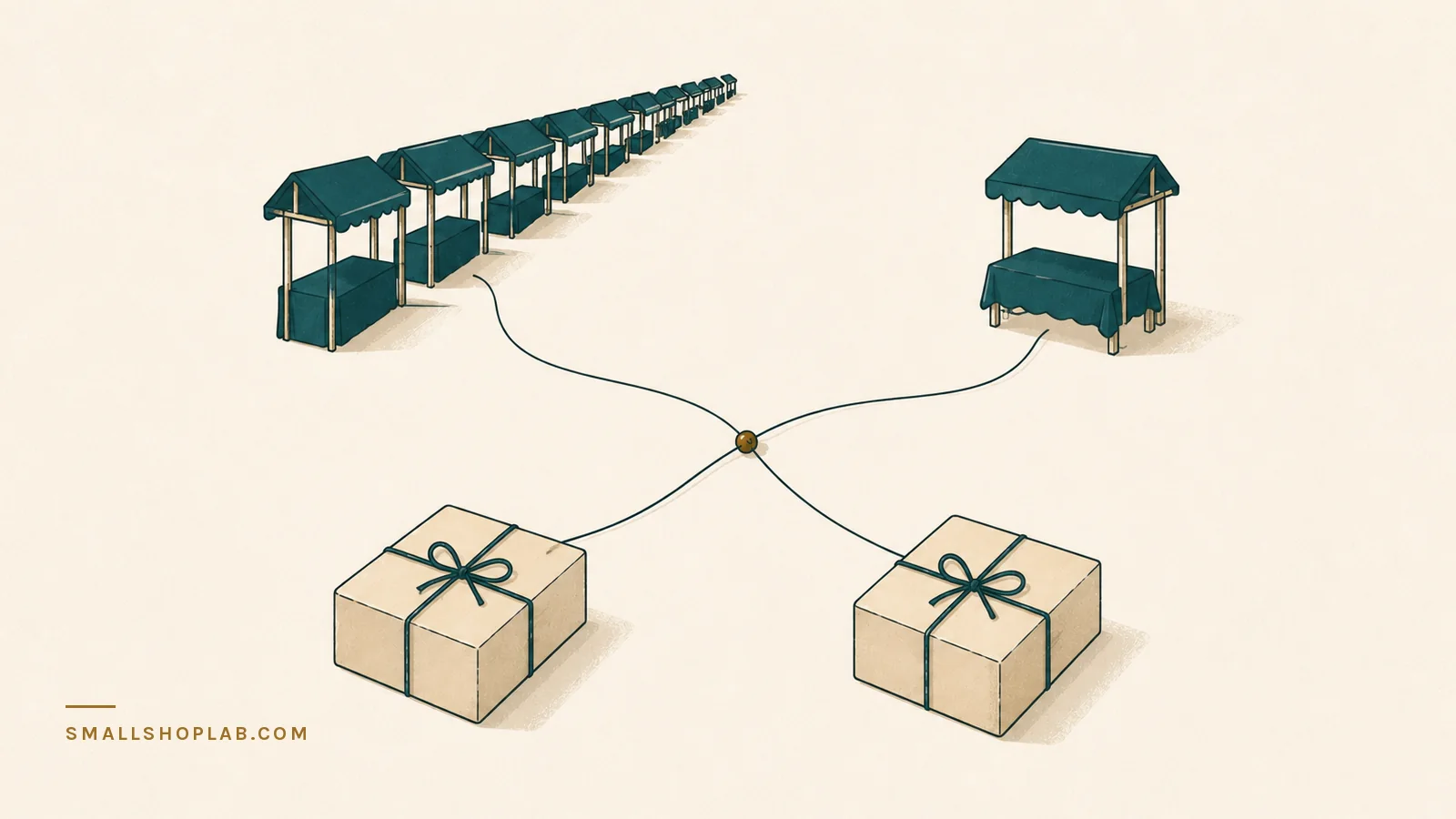
Etsy takes about 10.7% of a $38 order. Shopify takes about 3.7% plus $39 a month. Those two numbers cross at roughly 15 orders a month — and almost every “Etsy vs Shopify” article stops there, which is exactly where the real answer starts.
The two fee structures, side by side
Same $38 order, free shipping, US seller, September 2026 published rates.
| Etsy | Shopify Basic | |
|---|---|---|
| Monthly fee | $0 | $39 ($29 if paid yearly) |
| Listing fee | $0.20 per listing, renewed every 4 months and on each sale | — |
| Commission | 6.5% of item + shipping | — |
| Payment processing | 3% + $0.25 | 2.9% + $0.30 |
| Cost of one $38 order | $4.06 (10.7%) | $1.40 (3.7%) |
Per order, Shopify is $2.66 cheaper. Divide the $39 monthly fee by $2.66 and you get the number everyone quotes:
The break-even is about 15 orders a month at $38 each — around 11 if you pay Shopify yearly. Below that, Etsy costs less. Above it, your own store does, and the gap widens fast.
Why that number is almost useless on its own
Because it prices the checkout and ignores the shop window.
Etsy’s 10.7% is not only a payment fee. It buys placement in a marketplace that people already open when they want to buy handmade. Shopify’s 3.7% buys a checkout and nothing else. The traffic is entirely your problem, and traffic is not free — it costs money, or it costs months.
So the honest comparison isn’t 10.7% against 3.7%. It’s 10.7% against 3.7% plus whatever it costs you to get one person to your own store.
What traffic costs, from my own account
I run my own store, not an Etsy shop, so this is the side of the argument I’ve actually paid for. Over three years I spent about $1,064 on Meta ads. One campaign was built to drive sales; it spent $15 and produced 22 adds to cart at about 69 cents each.
Sixty-nine cents sounds wonderful next to Etsy’s $4.06. But an add to cart is not a sale. I don’t have clean purchase attribution on that campaign, so I’ll do the arithmetic openly rather than pretend I have a number I don’t:
| If this share of adds-to-cart become orders… | …each order costs | vs Etsy’s $4.06 |
|---|---|---|
| 50% | $1.38 | Cheaper than Etsy |
| 20% | $3.45 | About the same |
| 10% | $6.90 | Nearly twice Etsy |
| 5% | $13.80 | More than three times Etsy |
That table is the whole argument. Your own store is cheaper only if you can get people to it for less than the marketplace charges to hand them to you. For most people starting out, you cannot — not for the first year.
The comparison Etsy sellers should actually run
There’s a line item on Etsy that makes the two systems directly comparable: Offsite Ads. When Etsy advertises your listing on Google or Instagram and the click turns into an order, Etsy charges 15% — about $5.70 on our $38 order.
That is not a marketplace fee. That is a customer acquisition cost, and it is priced the way a paid ad is priced: only when it works.
| Route to one $38 order | What it costs you |
|---|---|
| Etsy, buyer already on Etsy | $4.06 — 10.7% |
| Etsy, buyer arrived via Offsite Ads | $9.76 — 25.7% |
| Own store, buyer arrived free (search, email, repeat) | $1.40 + your share of the $39 — under 8% at 15 orders/mo |
| Own store, buyer arrived via a paid ad | $1.40 + your real cost per order — the number most sellers never calculate |
Notice that rows two and four are the same business model with different logos. And notice that row three — the one everybody is chasing — depends entirely on having built something that brings people back without paying each time.
What I’d actually do
Under about 15 orders a month: stay on Etsy. Paying $39 for a store that no one can find is not independence, it’s a subscription to a private room. Use the marketplace’s traffic while it’s the cheapest traffic available to you.
Between 15 and 50: open your own store, but keep the Etsy shop. The fee saving now pays the monthly fee, and you can build the email list Etsy will never give you access to. Don’t close a working channel to prove a point.
Above 50, or with a real email list: your own store carries the business and Etsy becomes an acquisition channel you can measure — and switch off if the maths stops working.
One thing worth saying plainly: this is not a moral question. Etsy is not exploiting you at 10.7%; that is a normal marketplace rate for delivered demand. It’s simply an expensive way to serve a customer who would have bought from you anyway. The fee is fine on new buyers and terrible on repeat ones, which is the entire reason to own an email list.
A note on the third option
My own store runs on WooCommerce, not Shopify. It costs a few dollars a month for hosting instead of $39, and the payment fees are whatever your gateway charges — often similar to Shopify’s. What you save in subscription you pay in time: updates, backups, plugins, and being the person who fixes it at 11pm.
If you enjoy that, WooCommerce is the cheapest option by a wide margin. If you don’t, the $39 is buying something real, and pretending otherwise is how people end up with a broken store and no sales.
Work out your own number
- Count last month’s orders and your average order value.
- Work out what those orders cost you on Etsy — use the calculator if you’d rather not do it by hand.
- Work out what the same orders would cost on your own store: 2.9% + $0.30 each, plus the monthly fee.
- Subtract. If your own store saves less than the monthly fee, the decision is made for you this month.
- If it saves more, ask the harder question before switching: where would those orders have come from, without the marketplace? Write down an actual answer. “SEO” is not an answer; “I have 400 email subscribers who open” is.
Sources: Etsy fees and Shopify pricing, both read 4 September 2026. Rates change — check before you decide on them.
Wherever you end up selling, the price has to carry the fees. The handmade pricing formula is how I build one that does.
Questions people ask about this
Which is cheaper, Etsy or my own store?
On fees alone, your own store — but the comparison is misleading. Etsy’s cut is about 10.7% of an order; a hosted store is roughly 3.7% plus a monthly subscription. The two cross at around fifteen orders a month.
That crossover is the least important number in the decision, because it prices the checkout and ignores where the buyer came from.
What does the fee comparison leave out?
Traffic. Etsy’s percentage buys placement in a marketplace people already open when they want to buy handmade. A store subscription buys a checkout and nothing else.
The honest comparison is 10.7% against 3.7% plus whatever it costs you to get one person to your own store — and in my own advertising account that number was real money, not zero.
When does an own store actually make sense?
When you already have somewhere the buyer comes from — an audience, a list, repeat customers, or ads that pay for themselves. The store is worth having when it is the destination, not the plan.
If nothing sends people to it, the lower fee is a discount on sales that are not happening.
Can I run both?
Yes, and most shops that move do it gradually: keep selling where the buyers already are, and use every order to build something you own — an email address most of all.
Then the switch is a decision you make once the traffic exists, rather than a bet you place before it does.
Leave a Reply