
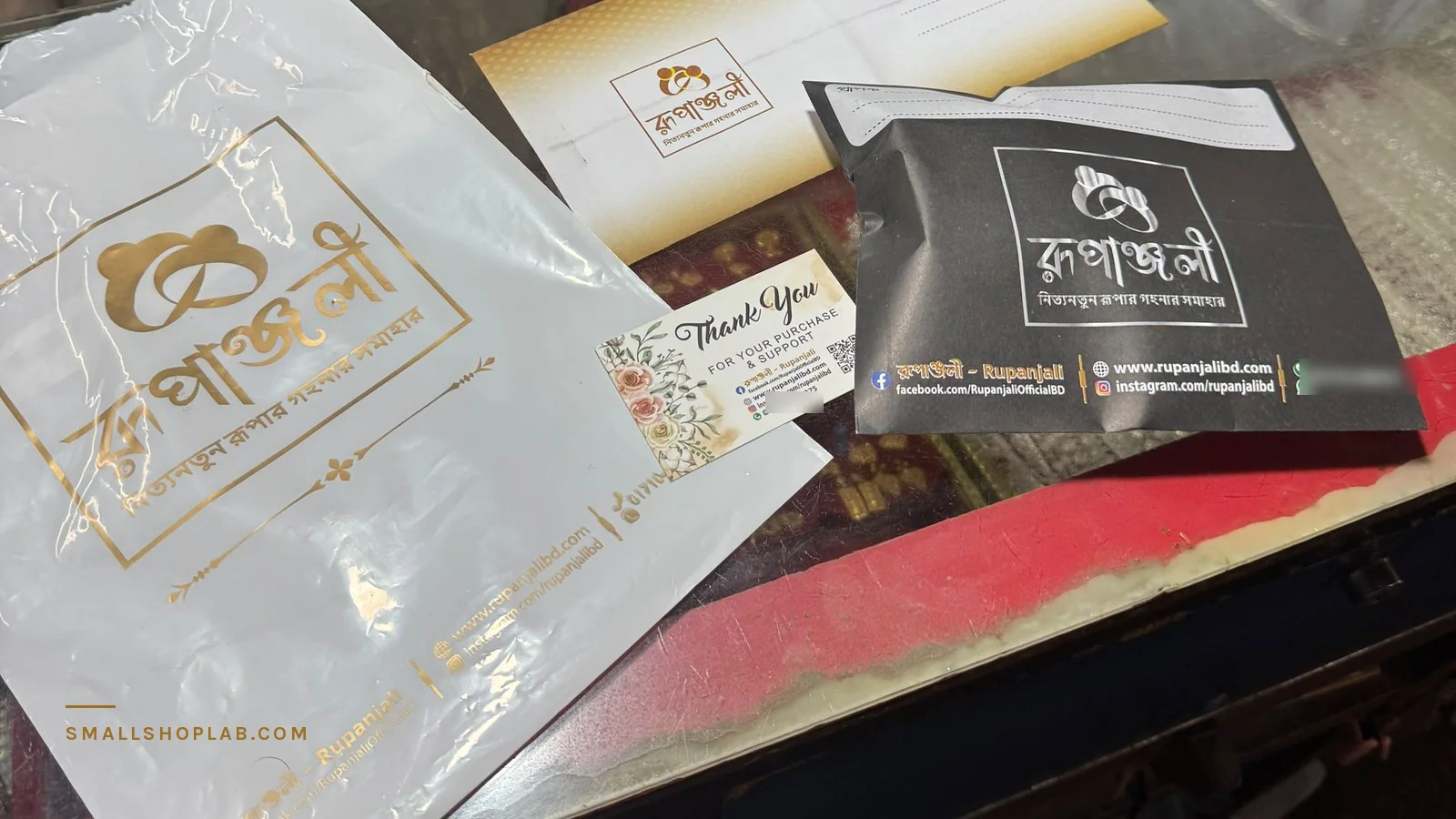
I ship silver jewelry from Bangladesh and lose zero to one parcel in a hundred to breakage or loss. Meanwhile about twenty in a hundred come back to me — and not one of those is because something arrived broken. Packing is a solved problem. Returns are not, and they are not the same problem.
Where these numbers come from
My own shop, from my own records, as of 4 September 2026. Roughly 400 pieces listed, every one unique, packed by hand and handed to a courier by me. The packing method below is not a recommendation I read somewhere — it is the one that produced that breakage rate at real volume, which makes it a tested claim rather than a guess.
What I am not doing is quoting US postage rates at you. Those are in what free shipping actually costs you, checked against USPS’s published rates. This post is about what goes inside the parcel and why.
What is actually in one of my parcels
| Layer | Its actual job |
|---|---|
| Jewelry box | Stops the piece moving. Movement, not impact, is what tangles chains and bends thin settings |
| Bubble wrap or tissue around the box | Takes the crush load so the box keeps its shape in a sack under other parcels |
| Poly courier bag | Weatherproofing and a tamper-evident seal. Also keeps the parcel light, which is the whole cost argument |
| Thank-you card | The only reason a buyer photographs the unboxing, and the cheapest thing in the parcel |
| Brand sticker | Seals the box and makes an ordinary poly bag look deliberate |
Five items. No rigid mailer, no void fill, no printed box. For jewelry that is enough, and the reason is worth understanding rather than copying blindly.
Why jewelry survives when other things don’t
Jewelry is small, dense and mostly not brittle. It does not break from being dropped — a silver anklet does not care about a two-foot fall. It gets damaged by two things instead:
- Movement inside the packaging. A chain that can slide around will tangle, and a fine chain that tangles under pressure kinks permanently. This is what the box solves — not by being strong, but by being small enough that nothing can travel.
- Crush. Not the parcel being hit, but the parcel spending six hours at the bottom of a sack. That is what the layer around the box is for. Its job is to keep the box a box.
Solve movement and crush and you have solved jewelry shipping. Everything else in a packaging supplier’s catalogue is solving a problem you do not have, at a cost per order that comes straight out of a margin most sellers have never actually measured.
The finding that surprised me
About one parcel in five comes back to me. The main reason is not damage, not dislike, not “changed my mind” — it is that the customer does not answer the phone when the courier arrives. That is a contact problem, and it costs me ৳120 a parcel.
I spent a long time assuming returns were a product problem, because that is where everyone looks first. Better photos, better packing, better descriptions. None of that was ever going to move a number caused by an unanswered phone.
What moves it is calling the buyer to confirm before the parcel goes to the courier. That is not a packaging upgrade or a copywriting fix. It is a step added before shipping, and it is the highest-value ten minutes in my day — because at 20% returns and ৳120 a return, the cost lands as ৳30 on every delivered order, whether it went well or not. The full arithmetic is in the margin breakdown of my own shop.
What translates to a US or UK seller, and what doesn’t
| Copy this | Don’t copy this |
|---|---|
| Small rigid box inside a soft outer — the two-layer principle | My exact materials. Buy locally, in your own currency |
| Keeping the parcel light and flat enough for the cheapest letter or small-packet rate | My courier rates. Yours are a different structure entirely |
| Confirming the order before it ships | My 20% return rate. Cash on delivery drives it, and you probably don’t use COD |
| Measuring what one return actually costs you | Assuming your return reason is the same as mine — find yours |
If you sell in the US or UK, your version of my phone problem is usually the address and the delivery window: a parcel that needs a signature nobody is home for, or an address the buyer typed wrong at checkout. Same shape of problem, same fix — verify before it ships, not after it comes back.
Three things to do with this
- Weigh a packed parcel before you buy any more packaging. Postage is priced in bands. If your current packing pushes you into the next band, the mailer is costing you far more than it costs.
- Write down why your last ten returns came back. Ten is enough to see the pattern. Most sellers have never done this and are solving the wrong problem with real money.
- Spread your return cost across every delivered order. Return rate times the cost of one return. That figure belongs in your price, because it leaves with every parcel whether the parcel comes back or not.
All figures are from my own shop, as of 4 September 2026. Currency converted at 122.63 BDT to the dollar, the rate on 3 September 2026.
Questions people ask about this
How do you pack a necklace so it doesn’t tangle?
Stop it moving. A chain tangles because it has room to travel, so the fix is a box small enough that the piece cannot slide, not more padding around a big box. Fastening the clasp before it goes in helps for the same reason.
Do I need a rigid mailer or is a poly bag enough for jewelry?
A poly bag is enough if there is a rigid box inside it. The box handles movement, a soft layer around it handles crush, and the bag handles weather and tampering. I have run that combination at real volume with breakage of zero to one parcel in a hundred.
How much should packaging cost per order?
Mine is ৳150–250 including the courier — about $1.22–$2.04. The number that matters is not the absolute cost but its share of your net profit per delivered order. Mine is ৳150 net per order, so packaging decisions are not small decisions for me.
Does better packaging reduce returns?
Only if your returns are caused by damage, and mine are not — breakage runs at zero to one in a hundred while returns run at one in five. Find out why yours come back before spending money on packaging to fix it.
Is a thank-you card worth including?
It is the cheapest item in the parcel and the only one that ever gets photographed. That does not make it a growth strategy, but at a few cents it does not have to work often to pay for itself.
Leave a Reply